

Hello, I’m Jeffrey, I’m a former English major, and all I got from it was this incomplete list of books that I had to read to get my degrees. (Kidding! Only sort of.) But I did spend almost a decade of my life studying English literature, during which, unsurprisingly, I had to read a lot of books. I have both a college diploma in Arts, Literature, and Communications, and a B.A. in English Literature. This basically just means that I had to read and analyze a thousand books over very short time periods, which basically means I know what I’m talking about when it comes to books. Or, at least, the books that I’ve read.
I’m from the French Canadian province of Quebec, where I first had to attend a post-secondary college known as CEGEP. That’s where I first majored in Literature in a two-year pre-university program. After that, I continued on to university, where I majored again in English Literature. Suffice to say I studied English lit for a long time. I’d like to say it ruined my ability to read for pleasure, but who are we kidding? It gave me a deeper appreciation of literature of all kinds. So I compiled this list of 20 books I had to read during my degrees and revisited my thoughts on each of them, since it was a lot of the books on this list that gave me that ability to appreciate the words and books that I still love today. Other books on this list made me question my will to live, and that’s just the way the wind blows sometimes. Scroll on to learn which books were which.
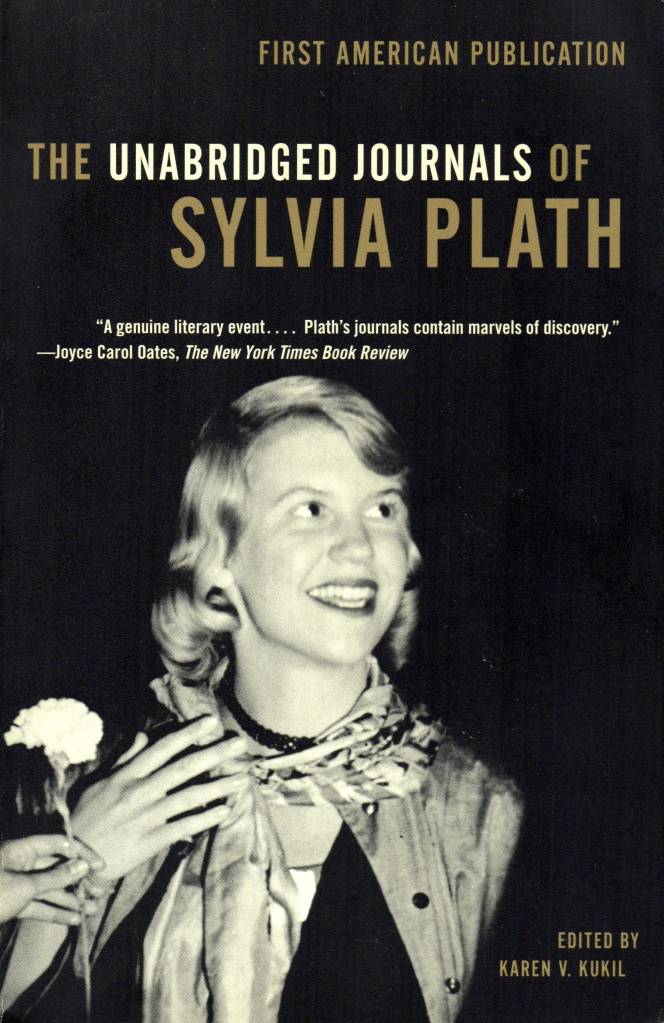
The Unabridged Journals of Sylvia Plath edited by Karen Kukil
Synopsis: A major literary event — the complete, uncensored journals of Sylvia Plath, published in their entirety for the first time. Plath’s journals were originally published in 1982 in a heavily abridged version authorized by Plath’s husband, Ted Hughes. This new edition is an exact and complete transcription of the diaries Plath kept during the last twelve years of her life. Sixty percent of the book is material that has never before been made public, more fully revealing the intensity of the poet’s personal and literary struggles, and providing fresh insight into both her frequent desperation and the bravery with which she faced down her demons. The complete journals of Sylvia Plath is essential reading for all who have been moved and fascinated by Plath’s life and work.
What I remember: Okay, I was definitely never assigned to read the entirety of Plath’s unabridged journals, which is quite a thick volume. (I did have a professor once tell us that they’ve never been able to make it through the whole book cover to cover, but looks like I have!) But I was assigned to read multiple excerpts from it in multiple classes during my college degree, and it kickstarted my lifelong love/obsession with Sylvia Plath. She was so ahead of her time, and her journals so capture perfectly that awkward and painful stage of life between adolescence and adulthood.

Possession by A.S. Byatt
Synopsis: Possession is an exhilarating novel of wit and romance, at once an intellectual mystery and a triumphant love story. It is the tale of a pair of young scholars researching the lives of two Victorian poets. As they uncover their letters, journals, and poems, and track their movements from London to Yorkshire — from spiritualist seances to the fairy-haunted far west of Brittany — what emerges is an extraordinary counterpoint of passions and ideas.
What I remember: This is definitely a case of romanticizing a past experience that you actually found painful at the time. Which is to say that myself and all my friends in the introduction to Victorian literature class we took did not enjoy ourselves while reading Possession. I believe we all really bought into the premise as lit nerds, but getting through this book was such a chore. That I do remember clearly. But I also remember liking the overall idea and aesthetic of the story, and I guess that’s what’s stuck with me. I have since revisited the 2002 film adaptation with Gwyneth Paltrow and Aaron Eckhart many times.

To the Lighthouse by Virginia Woolf
Synopsis: The serene and maternal Mrs. Ramsay, the tragic yet absurd Mr. Ramsay, and their children and assorted guests are on holiday on the Isle of Skye. From the seemingly trivial postponement of a visit to a nearby lighthouse, Woolf constructs a remarkable, moving examination of the complex tensions and allegiances of family life and the conflict between men and women. As time winds its way through their lives, the Ramsays face, alone and simultaneously, the greatest of human challenges and its greatest triumph — the human capacity for change.
What I remember: What I DO remember is suffering through this book not ONCE but TWICE and I can’t remember which time was more painful. I get why it’s a classic, because it’s very easy to deconstruct and analyze, and it remains a prominent piece of modernist literature because Woolf’s writing style was quite revolutionary for the time. It’s worth the read in the sense that you can read To the Lighthouse and understand why it’s considered classic literature. It’s therefore perfect homework reading material and that doesn’t necessarily mean you will enjoy it. I love you, Virginia, but this prose is just so dry. So aside from the revolutionary use of plot devices and literary style? Go girl give us nothing.
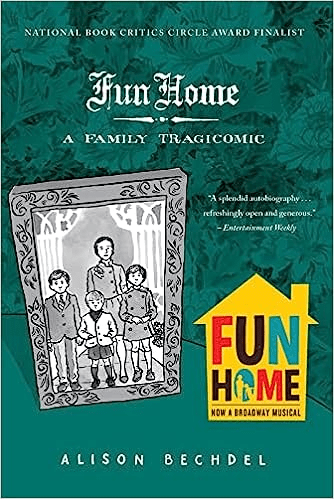
Fun Home by Alison Bechdel
Synopsis: In this graphic memoir, Alison Bechdel charts her fraught relationship with her late father. Distant and exacting, Bruce Bechdel was an English teacher and director of the town funeral home, which Alison and her family referred to as the Fun Home. It was not until college that Alison, who had recently come out as a lesbian, discovered that her father was also gay. A few weeks after this revelation, he was dead, leaving a legacy of mystery for his daughter to resolve.
What I remember: I’m pleased to report that the first graphic novel I ever read was in college, and it was Fun Home. I just never connected with graphic novels when I was a kid, and they definitely weren’t as common as they are now. The most I ever read of the genre were my Garfield Fat Cat 3-pack books. And since I read Fun Home the year I was really coming to terms with my own sexuality for the first time, it was a delight to read. The Goodreads review I wrote at the time, dated October 23, 2016, reads, “My only complaint about this book is that I would have enjoyed it much more if it wasn’t a graphic novel.” But now I think I’m grateful that Fun Home is a graphic novel, because I’ve read so many more of them since then, and it’s a genre that allows creativity to truly flow in a way that other genres don’t.
Frankenstein by Mary Shelley
Synopsis: Obsessed with creating life itself, Victor Frankenstein plunders graveyards for the material to fashion a new being, which he shocks into life with electricity. But his botched creature, rejected by Frankenstein and denied human companionship, sets out to destroy his maker and all that he holds dear. Mary Shelley’s chilling Gothic tale was conceived when she was only eighteen, living with her lover Percy Shelley near Byron’s villa on Lake Geneva. It would become the world’s most famous work of horror fiction, and remains a devastating exploration of the limits of human creativity.
What I remember: I have had to read and analyze this singular text far too many times than any human being ever should have to in one lifetime. Not only did I have to read it during my college degree and dissect it in two different classes, but then it kept showing up a few times in university, as well. I knew Frankenstein himself up above must have been screwing with me when, during one of my very last elective literature courses I needed to graduate with my B.A., I had to read and write an essay on mother-flipping Frankenstein once again. That last essay was so uninspired I received my lowest ever grade on an English course essay, but it didn’t matter to me. I was free. So, what do I remember? The torture, and my new life’s mission to never have to look at, or at the very least read, this book ever again.
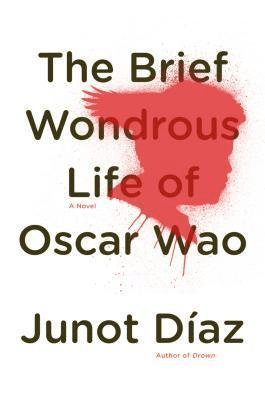
The Brief Wondrous Life of Oscar Wao by Junot Díaz
Synopsis: Things have never been easy for Oscar, a sweet but disastrously overweight, lovesick Dominican ghetto nerd. From his home in New Jersey, where he lives with his old-world mother and rebellious sister, Oscar dreams of becoming the Dominican J. R. R. Tolkien and, most of all, of finding love. But he may never get what he wants, thanks to the Fukœ — the curse that has haunted the Oscar’s family for generations, dooming them to prison, torture, tragic accidents, and, above all, ill-starred love. Oscar, still waiting for his first kiss, is just its most recent victim. Díaz immerses us in the tumultuous life of Oscar and the history of the family at large, rendering with genuine warmth and dazzling energy, humor, and insight the Dominican-American experience, and, ultimately, the endless human capacity to persevere in the face of heartbreak and loss.
What I remember: I remember there being a lot of themes of systemic racism, toxic masculinity, and internalized homophobia in The Brief Wondrous Life of Oscar Wao, and that for me at the time I wasn’t sure how those things made me feel. Most of the time I spent reading this book was spent feeling so bad for Oscar, who time and time again was measuring himself by the standards that society was telling him he needed to meet, rather than just listening to his heart. In the immortal words of Kat Stratford, “Why should I live up to other people’s expectations instead of my own?” And to quote from my own Goodreads review dated November 24, 2016, “Be a nerd if you want to and you don’t have to define yourself by your relationship status. I wish someone had given Oscar a hug and told him that.”

The Wind in the Willows by Kenneth Grahame
Synopsis: One of the best-known classics of children’s literature, a timeless masterpiece and a vital portrait of an age, The Wind in the Willows began originally in Kenneth Grahame’s letters to his young son, where he first recounted the adventures of Rat and Badger, of Mole and Toad —all narrated in virtuoso language ranging from lively parody to elaborate fin-de-siècle mysticism. Yet for a children’s book, it is concerned almost exclusively with adult fear of radical changes in political, social, and economic power.
What I remember: Until I had to read The Wind in the Willows for a children’s literature class, I thought that I had read this book in childhood, one with fancy pages and lots of illustrations that was very child-friendly. But the book that I read in college was in no way the book I remembered. Although it’s classified as a children’s book, it’s incredibly mature in subject matter and prose. I enjoyed having to read and analyze it that time around, but it was a little dense. I’d sooner recommend you watch the Disney animated classic The Adventures of Ichabod and Mr. Toad, which will give you the gist of the story.

Peter Pan in Kensington Gardens & Peter and Wendy by J.M. Barrie
Synopsis: In Peter Pan in Kensington Gardens, J.M. Barrie first created Peter Pan as a baby, living a wild and secret life with birds and fairies in the middle of London. Later Barrie let this remarkable child grow a little older and he became the boy-hero of Neverland, making his first appearance, with Wendy, Captain Hook, and the Lost Boys, in Peter and Wendy. The Peter Pan stories were Barrie’s only works for children but, as their persistent popularity shows, their themes of imaginative escape continue to charm even those who long ago left Neverland.
What I remember: Another memorable assignment from that same children’s literature class, it took me until college to learn that there was a Peter Pan prequel in the form of Peter Pan in Kensington Gardens, which reads like a Victorian fairy tale and gives lots of insight into the lore of the boy who never grew up. Peter and Wendy is the Pan story we all know and love, which had originated as a stage play called Peter Pan in 1904. That being said, a huge literary pet peeve I developed after having to read these two books for school is that, today, you are most likely to walk into a bookstore and find a book called Peter Pan by J.M. Barrie in the classics section. Although the story did originate as a play called Peter Pan, its novel form was published as Peter and Wendy. If you’re going to keep selling the book today, sell it under Peter and Wendy, its proper title. Thank you for coming to my TED Talk.

The English Patient by Michael Ondaatje
Synopsis: The nurse Hana, exhausted by death, obsessively tends to her last surviving patient. Caravaggio, the thief, tries to reimagine who he is, now that his hands are hopelessly maimed. The Indian sapper Kip searches for hidden bombs in a landscape where nothing is safe but himself. And at the center of his labyrinth lies the English patient, nameless and hideously burned, a man who is both a riddle and a provocation to his companions — and whose memories of suffering, rescue, and betrayal illuminate this book like flashes of heat lightning.
What I remember: PAIN. That’s what I remember. PAIN and SUFFERING. My god, I don’t think I so passionately disliked a book I had to read during my literature degrees as much as The English Patient. It’s the dryest, most lifeless prose you will ever read with a romance that makes you want to gauge your eyes out with your pencil just to make the reading experience end faster. What’s worse is that the professor for this course let us in on how The English Patient film adaptation became a pop culture punchline when it came out in the mid ‘90s, to the point of showing us YouTube clips of the episode of Seinfeld where Elaine hates The English Patient. And yet you still made us read and study it? Their name is in my revenge notebook.

Pygmalion by George Bernard Shaw
Synopsis: One of George Bernard Shaw’s best-known plays, Pygmalion was a rousing success on the London and New York stages, an entertaining motion picture and a great hit with its musical version, My Fair Lady. An updated and considerably revised version of the ancient Greek legend of Pygmalion and Galatea, the 20th-century story pokes fun at the antiquated British class system.
In Shaw’s clever adaptation, Professor Henry Higgins, a linguistic expert, takes on a bet that he can transform an awkward cockney flower seller into a refined young lady simply by polishing her manners and changing the way she speaks. In the process of convincing society that his creation is a mysterious royal figure, the Professor also falls in love with his elegant handiwork. The irresistible theme of the emerging butterfly, together with Shaw’s brilliant dialogue and splendid skills as a playwright, have made Pygmalion one of the most popular comedies in the English language.
What I remember: In high school, I used to find having to read plays for English class tedious, but all the plays I had to read during my literature degrees were actually good and worth the read. I remember Pygmalion being genuinely enjoyable and funny to read, despite the 3-star rating I gave it on Goodreads. (I was probably just feeling salty because I was forced to read it.) But the biggest revelation I had while studying Pygmalion? Renting My Fair Lady on DVD from the library to learn that, despite all of her greater qualities, Audrey Hepburn was not a musical singer and was completely and utterly miscast!

Against Nature by Joris-Karl Huysmans
Synopsis: With a title translated either as Against Nature or as Against The Grain, this wildly original fin-de-siècle novel follows its sole character, Des Esseintes, a decadent, ailing aristocrat who retreats to an isolated villa where he indulges his taste for luxury and excess. Veering between nervous excitability and debilitating ennui, he gluts his aesthetic appetites with classical literature and art, exotic jewels (with which he fatally encrusts the shell of his tortoise), rich perfumes, and a kaleidoscope of sensual experiences. The original handbook of decadence, Against Nature exploded like a grenade (in the words of Huysmans) and has enjoyed a cult readership from its publication to the present day.
What I remember: I read this for a course during my first semester of university in which we studied literary decadence in the late 19th century (also known academically as the “fin-de-siècle”), and I loved every second of that class. I thought Against Nature should resonate significantly amongst 21st century artists who are just so tired of everyone and everything so they hide away and just live life for art’s sake. Let’s roll the tape from my Goodreads review from March 8, 2018: “This book is literally about a man who hates everyone and everything, wants to live his life only for literature and art and interact with no one, and is ultimately driven insane by his own depressive solitude and isolation. One of the main themes seems to be don’t become like this guy (too late in my case, because RELATABLE) but there were a lot of other themes that open up a lot of discussion around a lot of issues so even though it was a bit boring and it felt like nothing happened in most chapters, I can’t help but say I enjoyed it.”
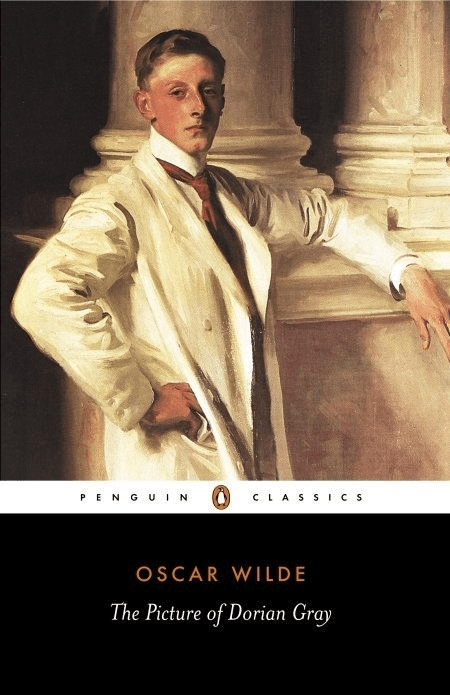
The Picture of Dorian Gray by Oscar Wilde
Synopsis: Oscar Wilde’s only novel is the dreamlike story of a young man who sells his soul for eternal youth and beauty. In this celebrated work, Wilde forged a devastating portrait of the effects of evil and debauchery on a young aesthete in late-19th-century England. Combining elements of the Gothic horror novel and decadent French fiction, the book centers on a striking premise: as Dorian Gray sinks into a life of crime and gross sensuality, his body retains perfect youth and vigor while his recently painted portrait grows day by day into a hideous record of evil, which he must keep hidden from the world. For over a century, this mesmerizing tale of horror and suspense has enjoyed wide popularity. It ranks as one of Wilde’s most important creations and among the classic achievements of its kind.
What I remember: I still boast that The Picture of Dorian Gray was the only book I had to read for my literature degrees that I rated 5 stars. And it still deserves all of those stars. It’s kind of a literary equivalent of “if you know you know” for English majors and book nerds. It remains a timeless masterpiece that continues to awe me. I wish Oscar Wilde had been around longer to write more works of art even gayer than this one.

Epistemology of the Closet by Eve Sedgwick
Synopsis: Since the late 1980s, queer studies and theory have become vital to the intellectual and political life of the United States. This has been due, in no small degree, to the influence of Eve Kosofsky Sedgwick’s critically acclaimed Epistemology of the Closet. Working from classic texts of European and American writers ― including Melville, James, Nietzsche, Proust, and Wilde ― Sedgwick analyzes a turn-of-the-century historical moment in which sexual orientation became as important a demarcation of personhood as gender had been for centuries.
What I remember: I found most of the literature class on gender and sexuality that I took to be unfortunately quite boring and hard to follow, mostly because the professor just loved the sound of their own voice. But it wasn’t all bad because it introduced me to Epistemology of the Closet, one of the best queer studies books you’ll ever read. (If, you know, you’re into that, which I’m guessing you are, otherwise you wouldn’t still be reading this.) In fact, one of the crowning moments in my English major career was actually a semester before I studied Epistemology when I was writing and researching an essay on Dorian Gray, and I came across Sedgwick’s work that I cited in my assignment. It was Epistemology that coined the term “glass closet,” in which there’s someone who everyone knows to be queer, but they aren’t officially out. That person would, according to Sedgwick, be living in a glass closet. This prompted me to title my Dorian Gray essay “People Who Live in Glass Closets Shouldn’t Throw Stones.” I got an A, thank you very much.
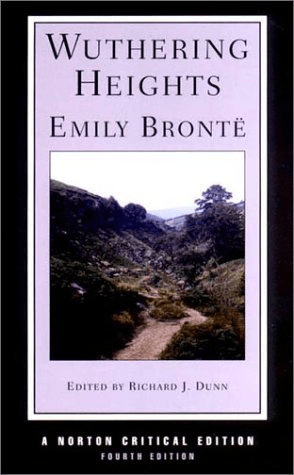
Wuthering Heights by Emily Brontë
Synopsis: Lockwood, the new tenant of Thrushcross Grange, situated on the bleak Yorkshire moors, is forced to seek shelter one night at Wuthering Heights, the home of his landlord. There he discovers the history of the tempestuous events that took place years before; of the intense relationship between the gypsy foundling Heathcliff and Catherine Earnshaw; and how Catherine, forced to choose between passionate, tortured Heathcliff and gentle, well-bred Edgar Linton, surrendered to the expectations of her class. As Heathcliff’s bitterness and vengeance at his betrayal is visited upon the next generation, their innocent heirs must struggle to escape the legacy of the past.
What I remember: What I loved about Wuthering Heights was that even if the story or romance isn’t typically your cup of tea, I don’t think there was anyone in my class that semester who didn’t end up admitting that it was very well written and has a loveable quality unmatched by a lot of other classics. I’d love to reread it someday.
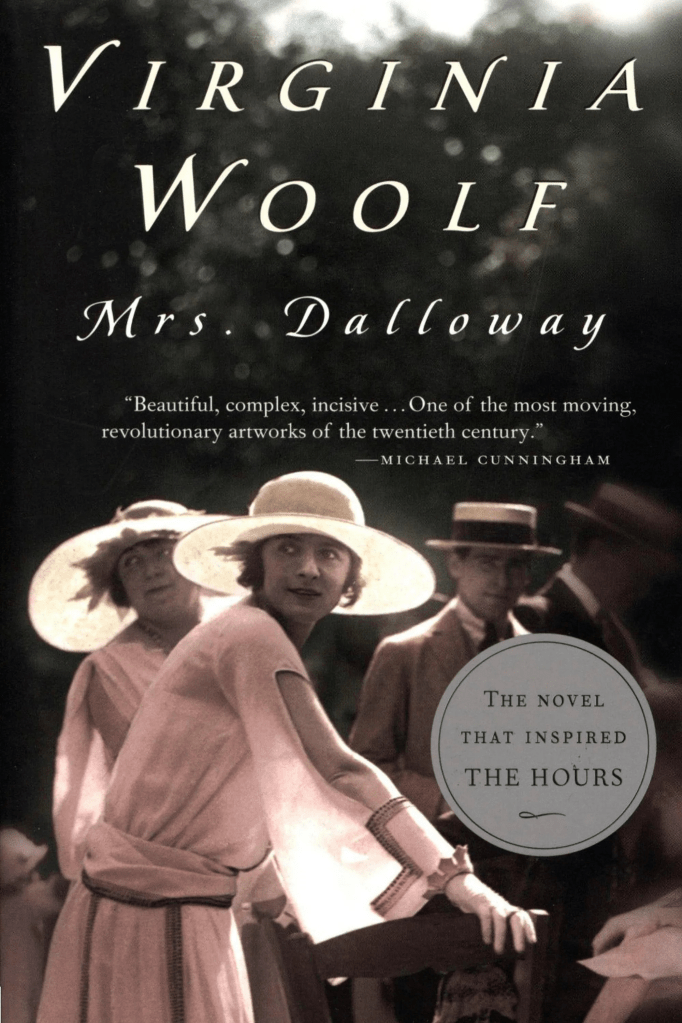
Mrs. Dalloway by Virginia Woolf
Synopsis: Heralded as Virginia Woolf’s greatest novel, this is a vivid portrait of a single day in a woman’s life. When we meet her, Mrs. Clarissa Dalloway is preoccupied with the last-minute details of party preparation while in her mind she is something much more than a perfect society hostess. As she readies her house, she is flooded with remembrances of faraway times. And, met with the realities of the present, Clarissa reexamines the choices that brought her there, hesitantly looking ahead to the unfamiliar work of growing old.
What I remember: I wouldn’t necessarily call the prose in Mrs. Dalloway any more lively than the prose in To the Lighthouse, but there’s so much more subtext that’s genuinely interesting in Mrs. Dalloway. If you have the patience for it, any work it might take to get through this book will pay off in the end. And once you’ve read Mrs. Dalloway, you can read Michael Cunningham’s The Hours, another masterpiece. (Perhaps you know the film adaptation where Nicole Kidman won her Oscar for Virginia Woolf’s prosthetic nose.)

The Bluest Eye by Toni Morrison
Synopsis: The Bluest Eye is Toni Morrison’s first novel, a book heralded for its richness of language and boldness of vision. Set in the author’s girlhood hometown of Lorain, Ohio, it tells the story of black, eleven-year-old Pecola Breedlove. Pecola prays for her eyes to turn blue so that she will be as beautiful and beloved as all the blond, blue-eyed children in America. In the autumn of 1941, the year the marigolds in the Breedloves’ garden do not bloom. Pecola’s life does change — in painful, devastating ways.
What I remember: I’m pretty sure most of the reason I only gave The Bluest Eye 3 stars was because the professor of the class I had to read it for was so boring. I dreaded attending their lectures even though the material, 20th Century Literature by Women, was something I was genuinely interested in. Toni Morrison’s work has seen a lot of renewed interest since the Black Lives Matter uprising of 2020, and for good reason. I do remember The Bluest Eye being a really good starting point to learning about systemic and institutionalized racism. And honestly, anything Toni Morrison wrote is gorgeous, so that’s good a reason as any to pick up her books now.

Jane Eyre by Charlotte Brontë
Synopsis: Charlotte Brontë tells the story of orphaned Jane Eyre, who grows up in the home of her heartless aunt, enduring loneliness and cruelty. This troubled childhood strengthens Jane’s natural independence and spirit — which prove necessary when she finds employment as a governess to the young ward of Byronic, brooding Mr. Rochester. As her feelings for Rochester develop, Jane gradually uncovers Thornfield Hall’s terrible secret, forcing her to make a choice. Should she stay with Rochester and live with the consequences, or follow her convictions — even if it means leaving the man she loves? A novel of intense power and intrigue, Jane Eyre dazzled readers with its passionate depiction of a woman’s search for equality and freedom.
What I remember: From the moment I started studying English literature, there was talk of Jane Eyre being something we needed to read at one point in our lives. I was only assigned it during my second year of university, which worked out well, because I don’t think I would’ve been mature enough for it right out of high school. Whether you’re studying this book or reading it for fun, Jane Eyre is definitely a book that lives up to the hype and a classic worthy of the name.
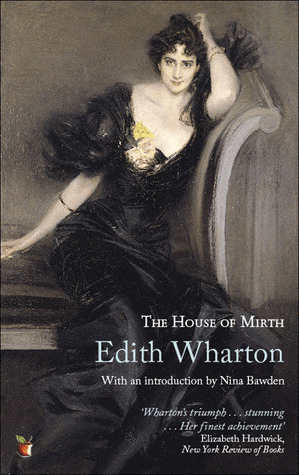
The House of Mirth by Edith Wharton
Synopsis: First published in 1905, The House of Mirth shocked the New York society it so deftly chronicles, portraying the moral, social and economic restraints on a woman who dared to claim the privileges of marriage without assuming the responsibilities. Lily Bart, beautiful, witty and sophisticated, is accepted by “old money” and courted by the growing tribe of nouveaux riches. But as she nears thirty, her foothold becomes precarious; a poor girl with expensive tastes, she needs a husband to preserve her social standing, and to maintain her in the luxury she has come to expect. Whilst many have sought her, something — fastidiousness or integrity — prevents her from making a “suitable” match.
What I remember: This is a book I enjoyed a lot in spite of the fact that the professor for this class also made it boring. I attribute my love and understanding of The House of Mirth to the fact that I basically had to teach it to myself, and once I really got into it, it became one of my favorite books that I had to read during my degrees. While the professor questioned some of my more modern research and comparisons in my final essay, they still ended up giving me a decent grade. Another classic I’d love to reread one day.
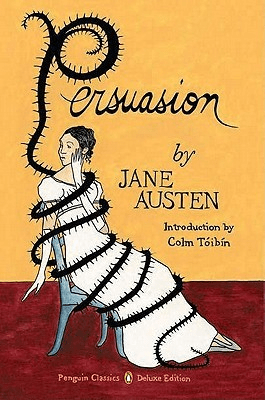
Persuasion by Jane Austen
Synopsis: At twenty-seven, Anne Elliot is no longer young and has few romantic prospects. Eight years earlier, she had been persuaded by her friend Lady Russell to break off her engagement to Frederick Wentworth, a handsome naval captain with neither fortune nor rank. What happens when they encounter each other again is movingly told in Jane Austen’s last completed novel. Set in the fashionable societies of Lyme Regis and Bath, Persuasion is a brilliant satire of vanity and pretension, but, above all, it is a love story tinged with the heartache of missed opportunities.
What I remember: I took an entire class on Jane Austen, and having never read a word of any of her books before, I went in to it with a completely open mind. By the time the class was over, my mind was significantly less open. I guess we can just say that Austen and I don’t mesh, at all. I thought every book was as boring and lifeless as the last. That being said, if I had to pick a favorite, I would say Persuasion. It was the only one of Austen’s novels that truly held my attention, and I enjoyed choosing it to analyze for the final assignment. Would I ever reread it, however? Probably…not.

Our Lady of the Lost and Found by Diane Schoemperlen
Synopsis: One Monday morning in April, a middle-aged writer walks into her living room to water the plants and finds a woman standing beside her potted fig tree. Dressed in a navy blue trench coat and white Nikes, the woman introduces herself as “Mary. Mother of God… You know. Mary.” Instead of a golden robe or a crown, she arrives bearing a practical wheeled suitcase. Weary after two thousand years of adoration and petition, Mary is looking for a little R&R. She’s asked in for lunch, and decides to stay a week.
As the story of their visit unfolds, so does the story of Mary — one of the most complex and powerful female figures of our time — and her changing image in culture, art, history, as well as the thousands of recorded sightings that have placed her everywhere from a privet hedge to the dented bumper of a Camaro. As this Everywoman and Mary become friends, their conversations, both profound and intimate, touch upon Mary’s significance and enduring relevance. Told with humor and grace, Our Lady of the Lost and Found is an absorbing tour through Mary’s history and a thoughtful meditation on spirituality, our need for faith, and our desire to believe in something larger than ourselves.
What I remember: This was one of the last books I ever had to read for my B.A., and while I did not really enjoy reading it all that much as a fairly non-religious person, analyzing Our Lady of the Lost and Found for an essay was actually quite interesting. That’s the thing with assigned reading for an English degree… I might’ve hated actually reading the book, but then when I have to sit down and analyze it for a grade, I almost always ended up finding something about it to appreciate, holding me back from full-on hating the book. There are a lot of hidden metaphors and allegories in this book, which made it fun to pick apart.


 Jeffrey Reads