
20 Questions is a Q&A interview series with authors, musicians, and everyone in between, celebrating experiences both shared and individual in the messy game of being human.
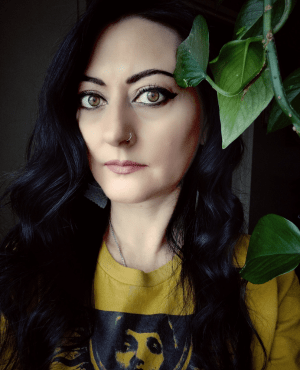
“Writers don’t always write. That’s bullshit. Everyone’s process is different. So, if you need to hibernate and not have anything to do with writing, you hibernate.” Hillary Leftwich is a neurodivergent multimedia writer and the author of Ghosts Are Just Strangers Who Know How to Knock and Aura. She teaches creative writing, business writing, and environmental writing and storytelling at several universities, writing organizations, and nonprofits for adults, previously incarcerated and hospitalized youth, and unhoused populations. She centers her writing around themes of class struggle, the impact of disease, mental illness, ritual, and the supernatural. On the outskirts of the writing world, she teaches tarot and tarot writing workshops focusing on strengthening divination abilities along with writing. Hillary joins me this week on 20 Questions to discuss her new poetry collection Saint Dymphna’s Playbook, on shelves now.
Growing up, did you always want to be a writer? Did you consider any other career paths?
My dad bought me an electric typewriter so I could type my 7-year-old horror stories out. I still have them today. As far as other career paths, I didn’t really consider any career because I was always working from a very young age. Working turned into more work and multiple jobs to make ends meet.
This is why I have always endeared myself to the working class and steered clear of academia for so long. I was also going to community college and cleaning motel rooms and wealthy folks’ homes, so when I stumbled upon Lucia Berlin’s writing, imagine my surprise making a connection between the jobs I was doing and being able to write about them.
What inspired you to want to write books?
I never considered writing books at first, just essays and stories. It never occurred to me, at least I didn’t allow myself to, that I could produce enough solid writing to compile into a book. But after several years of writing and stealing company time, I had enough to be able to publish my first collection. I had a mindset for years that no one would want to read what I was writing about because I was a single mom with a fucked-up life and I was constantly screwing up. Turns out, people love the other side of what’s out there.
If you could pick one author that’s inspired you the most, who would it be and why?
Ai Ogawa, hands down. She showed me a freedom with point of view and what she wrote about — oftentimes violence and content that are brutal and hard to read — that I didn’t know could be taken on with such confidence and explored in the way that she did.
Favorite book of all-time?
Kafka on the Shore. It showed me how surrealism can be done in a way that isn’t just for reactions and shock. Also, cats.
Your new poetry collection Saint Dymphna’s Playbook deals with themes of sexual assault, suicide, and the male gaze, and is described as a “playbook for survival.” How would you characterize it?
I think it’s a response to a lot of the trauma I have experienced as a girl and a woman along with the situations, both personal in nature as well as in my many different jobs, along with dealing with a long history of suicide starting as a teenager. But all of these are connected and have a timeline that I never considered until I began writing about them. Every piece in the collection is autobiographical, and every piece also echoes another woman’s story, another woman’s story, and another woman’s story.
Sometimes, the woman is me. Sometimes, the woman isn’t, and her story is being told because she’s not here to tell it herself. In my workshops, especially when I’m teaching the lyric essay, we talk about how our form must reflect something bigger than ourselves. This is what I have always tried to do — to echo the form into something larger that connects and hopefully shows bravery and that confidence I spoke about earlier that Ai Ogawa portrayed. I want that for every writer, and for those whose voices have been erased.
What’s one piece of advice that you would give to your younger self?
I actually wrote this line in my memoir, Aura: “Don’t give someone all of you when they take everything from you.”
One movie that will always make you cry?
I’m not going to act like the cool person and say some cool, obscure movie here. Beaches. Hands down, every damn time.
The last series you binge-watched?
Fleabag. I’m obsessed now.
If you could have one writer, dead or alive, to compose your obituary, who would it be and why?
This is a tough call, because there are two writers I adore that I would be honored to do so: Selah Saterstrom and Sarah Elizabeth Schantz. They would both honor me with gorgeous words that make me sound far better a human than I could ever hope to be.
The best book you’ve read in the last year?
I hate this question. It’s so hard to narrow down to just one. But I’m going to be selfish here, because I feel like it’s a book I can read over and over again. Strip by Hannah Sward. I identify and connect so much with her words I feel like I know her. Also, she’s a wonderful person who advocates for women, and this makes her book even more memorable.
One song that you will never be sick of?
“Sitting on the Dock of the Bay” by Otis Redding. It’s always been my favorite song.
Favorite thing to do on a rainy day?
Smell the rain. There is nothing else like it.
What’s the most challenging part of writing for you?
Trying to figure out what the words actually want to say, rather than what I want them to say. I often lead my students through a spirit-writing exercise which is very stream-of-conscious. We allow ourselves to understand that the page is alive, and the words we want to write have already existed, sometimes before we were even born. I think this takes the pressure of having to perform — to write beautiful words at the drop of a hat. To remember we are humans first.
You’re stuck on a long flight. Which world-famous musician would you want sitting next to you and why?
Can I change musician to sports figure? I’m a huge hockey fan, so I would love to have Patrick Roy sitting next to me so I could ask him all the questions I have about his time as a goalie. I find hockey fascinating, and always wanted to be a goalie myself, because they’re the weirdos of the team. I can appreciate and understand the game, the intricacies, the brutality, and the passion.
As a writer and artist, what would you say is the best way to rest or decompress?
Writers don’t always write. That’s bullshit. Everyone’s process is different. So, if you need to hibernate and not have anything to do with writing, you hibernate.
Favorite social media app?
Nextdoor. It gives you an unedited view of how people really feel without fronting that many sites like Facebook or Instagram do. It’s all smoke and mirrors, but not for Peggy who lives three doors down and swears there’s a guy dressed in a dog suit stealing the birdseed from her birdfeeder.
As a neurodivergent writer, what have you learned about your creative process that you might not have otherwise?
My process has always felt harder than others, although I’m sure many of us share this sentiment, right? I have always had an intimate relationship with words that has been different for me than everyone else in my life. I was called stupid in kindergarten because of my dyslexia, which only fed my determination to read more. Then I recently discovered I have a form of synesthesia, and that my ability to taste words isn’t what everyone else experiences (though I always thought so). It’s like any survival story where the hero comes out on top, except we don’t come out on top all the time, we wind up being the weirdos who create amazing shit.
How would you describe the importance of storytelling in an age of isolation?
Isolation can mean different things, but I feel storytelling always finds its way beyond this. Which is why libraries are so important. Which is why Substack, Patreon, your local open mic, comedy clubs, burlesque shows, drag shows are so important. All of these share the tradition of storytelling in some way or another, and especially now, sacred. I think we all collectively feel this way.
Laptop or desktop?
Laptop. It’s important to be able to commute at random.
What can we expect to see next from you?
I’m working on something now that is unexpected but has come about from my current life situationship. And rather than try to shape it into something it’s not, I’m just reacting to it as witness and not putting pressure on myself. It’s exciting and feels kind of dirty and dark and sexy in this manner. I fucking love the whole process. It feels like something teenage me would have loved to have write, had I known how to be brave then.
Follow Hillary Leftwich on Instagram and buy her poetry collection Saint Dymphna’s Playbook wherever books are sold.

 Jeffrey Reads