
Self-Analysis Addict is an essay series examining the pop culture, books, and music that have shaped me as a person. It’s also a book of essays that you can purchase here.
It should come as a surprise to absolutely no one that, as a devout lover of Disney animated films, the live-action remakes that the studio has spent the better part of the last decade producing have gotten me seated and ready almost every time a new one has hit theatres.
I don’t blindly love them all simply because they’re under the Disney banner. Rather, I am probably one of their toughest critics — merely because their animated source material has existed in my mind for almost all my life, and if something feels off or untrue to the story in its live-action adaptation, I am going to be suspicious. But sometimes I try to reserve judgment and try going into the theatre to enjoy the remake for what it is. This was exactly my approach with Snow White.
A live-action remake of Walt Disney’s first-ever animated feature film had been in the works for many years, with its development first reported as early as 2016, with Erin Cressida Wilson writing the screenplay. As The New York Times reported, Disney had allegedly been developing a live-action Snow White and the Seven Dwarfs since the 2000s. By 2019, Marc Webb had been attached as the director, and two years after that, Rachel Zegler was cast in the title role, and Greta Gerwig was reportedly in talks to join the writing team.
Zegler’s casting as a Latina woman was the subject of controversy, the same way “#NotMyAriel” trended on social media when Halle Berry, who is Black, was cast as Ariel in the live-action adaptation of The Little Mermaid. The controversy surrounding Zegler was also tinged by the classical interpretation of the Snow White character having skin as white as snow.
At the time, this all seemed par for the course. It was nothing the media hadn’t seen before when diverse casting news of beloved stories whose origins span centuries get announced. “You don’t normally see Snow Whites that are of Latin descent. Even though Snow White is really a big deal in Spanish-speaking countries,” Zegler stated during a Variety “Actors on Actors” segment in 2022. “We need to love [people] in the right direction. At the end of the day, I have a job to do that I’m really excited to do. I get to be a Latina princess.” The actress even came with a glowing recommendation from Steven Spielberg, who directed Zegler in his sadly-unsuccessful 2021 remake of West Side Story.
Nearly six months after Zegler, Gal Gadot was cast as the Evil Queen in the Snow White remake. Then, Martin Klebba, who had appeared as a dwarf in other adaptations of Snow White and the Seven Dwarfs, announced he had been cast as Grumpy in the new film, with other actors such as Titus Burgess and Jeremy Swift confirmed as joining the cast as other dwarfs.
Things changed, however, when Peter Dinklage, a prominent actor with a form of dwarfism, criticized Disney for continuing to perpetuate a retelling of a fairy tale that reinforces negative stereotypes for those with the condition. Disney responded to his claims saying they were working on creative ways around portraying the dwarfs as stereotypes; then other actors criticized Dinklage’s comments as taking opportunities away from actors with dwarfism. The dwarf controversy continued into 2023 when production shots from Snow White emerged, and in the final cut of the film, the seven dwarfs were now CGI-created mythical, immortal characters, never referred to as dwarfs.
By 2024, further controversies over the remake took centre stage. Zegler found herself in hot water by every corner of the media for comments she made two years prior about the original 1937 Disney animated film being dated and in need of an update. “The original cartoon came out in 1937 and very evidently so. There’s a big focus on her love story with a guy who literally stalks her. Weird! Weird. So we didn’t do that this time.”
I remember some media coverage of these allegedly controversial comments in 2022, but nothing like the media storm of bullying and hate-speech that would emerge surrounding Zegler leading up to Snow White’s ultimate release, after countless delays, in the spring of 2025.
Many supposedly devout Disney fans condemned Zegler for speaking ill of the original film, when what she said was in no way inaccurate. Also, she said those things two and a half years earlier, and the outrage was as if she sat down with 60 Minutes the weekend the film came out and spewed a bunch of hate towards the fairy tale she was part of adapting. Instead, a bunch of strangers on social media were suddenly spewing hate at her. Zegler wasn’t the only actress from the film to find herself at the centre of controversy leading up to Snow White’s release, either.
When the first trailer was unveiled in the summer of 2024, the Palestinian Campaign for the Academic and Cultural Boycott of Israel (PACBI) and Boycott, Divestment, and Sanctions (BDS) demanded a boycott of the live-action Snow White as a result of Gal Gadot’s Zionist stance in the face of the Israel-Hamas war. Things only got worse when it became clear on social media that Zegler and Gadot had opposing views on the conflict surrounding Israel and Palestine — except when Gadot received death threats during production of the film, Disney provided extra security for her.
As if things couldn’t get any worse in the production of a family-friendly fairy tale adaptation, Zegler found herself in trouble again when, upon the re-election of Donald Trump as President of the United States, she denounced him on social media with poignant use of a certain expletive. She later issued a public apology.
When Snow White finally premiered, The New York Times referred to it as “one of the most troubled projects in Disney’s 102-year history” and suggested that the long list of controversies that ultimately plagued its box office performance were a result of the cultural shifts that occurred between 2019, when Disney live-action remakes were at an all-time high, and 2021, when Snow White was able to start production.
In 2019, people were happier. Sure, Trump was President, but we hadn’t yet faced the enormous cultural trauma caused by the pandemic. Even as winds of change mildly blew in with the election of Joe Biden’s Democratic government, right-wing extremism continued. Casting a Latina actress as a Disney Princess whose name has “white” in it was, in retrospect, a recipe for disaster in that cultural climate, but still necessary for responsible representation.
By the time Snow White was released, in the wake of so many hullaballoos, the film’s crew tried to focus on the positives. “Our job is to delight,” producer Marc Platt told The New York Times. “I’m hopeful that once audiences actually experience the film, all the noise around it will fade away and people will discover a family entertainment that is joyful, aspirational and delightful.”
Platt was also the one who was reported to have flown from Los Angeles to New York to convince Zegler to delete her social media post accompanying the film’s 2024 trailer in which she added, “And always remember, free Palestine.” It was this post, so the narrative goes, that inserted Snow White discourse into the political conversation, allegedly causing a rift between Zegler and Gadot, and the wrong kind of PR for Disney. While Zegler heeded Platt’s advice, it didn’t stop her from condemning Trump that November, and this time Disney decided to respond with silence.
Snow White was released to abysmal reviews, criticizing just about everything except Zegler’s performance. Gadot’s portrayal of the Evil Queen and her own polarizing political views further tainted interpretations. The controversies plagued box office numbers and made it impossible for it to succeed financially, yet director Marc Webb stood by his adaptation of the classic Disney fairy tale. “Now that people are seeing the movie, I think they’re surprised and warmed by how nostalgic it is. This movie is nostalgic not just in its aesthetic but in its worldview,” he told The New York Times. “It’s wholesome and kind, and that’s what I’ve held sort of dear through this whole process.” I have to agree.
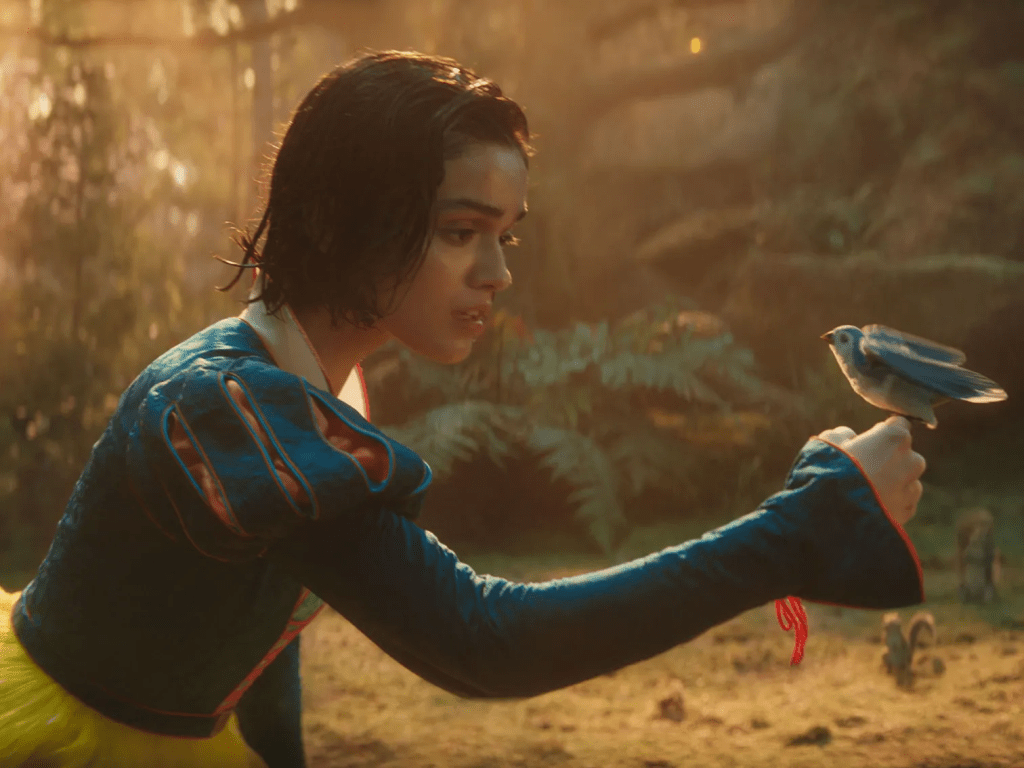
I sat in the movie theatre watching Snow White feeling very satisfied with how the live-action filmmakers handled one of the most-rewatched movies of my childhood, having chosen to remain blissfully ignorant to the rampant controversies that had surrounded the film leading up to its release. The cinematography was impressive, the new original songs lovely, Rachel Zegler a wonderful choice.
Gal Gadot, while not one of my favorite actresses, brought a camp sensibility to the role of the Evil Queen which, despite her off-putting political opinions and limited performance range, worked oddly well for me. Upon second and third viewings of Snow White, I was honestly captivated by Gadot’s performance, as long as I interpreted it as camp and nothing else — even her own musical number “All is Fair” became a highlight, mostly because Disney villain musical numbers have become so underrated, and they need to become mainstays again.
But when I left the theatre after that first screening, I was thrust into the real world that was putting so much real-life emphasis on what is, after all, a Disney live-action musical produced for a family audience. Some of it was justified. I won’t fault those who chose to boycott Snow White as a result of Gadot’s views and political affiliations. I will not, however, accept nor forget the sheer amount of bullying and hatred leveled at Zegler who, as most reputable reviews pointed out, gave an amazing performance in the titular role and followed Disney’s lead by responding to the continuing controversies with silence.
But that doesn’t mean the studio is at all exempt from blame in this scenario, one where they spent upwards of $200 million on a live-action remake of a beloved children’s classic that should have done fairly well at the box office had it not been for the culture wars of our current era clouding what is, once again, a PG-rated live-action Disney movie.
Rather than speak on Gadot’s own role in the film’s financial failure, since a considerable amount of boycotts as a result of her involvement did in fact occur, Disney leveled Snow White’s many real-world failures on Zegler’s inability to keep her opinions to herself and off social media. And rather than lean into the actress’s Gen Z sensibilities and audience, they alienated them by publicly chastising her and trying to blame Snow White’s underperformance on a 24-year-old rising star. Remind me again how our current media landscape is supposedly so much more attuned to women’s issues, minority representation, and gender equality?
I wish it were as simple as politics have no place in the fairy tale realm of Snow White, but politics are a part of everything, especially in the 2020s. No piece of media large or small is without making a political statement. Whether Disney chose to make the wrong ones by replacing real-life dwarfs with CGI mythical, dwarf-like creatures or cast the wrong actress because she wasn’t “white” enough or supposedly “badmouthed” its dated source material is actually irrelevant.
The real issue that plagued Snow White, outside of the aforementioned culture wars, is that a sing-songy live-action fairy tale musical had no business being as happy and hopeful as it did in the year 2025, and that made people upset.
To live in the world of Snow White is to still believe. To believe in the inherent goodness that can still exist in our worlds despite evil, totalitarian regimes. To believe that small acts of kindness can go a long way for someone struggling to get by. That making wishes on a well and belting out what’s sure to become Disney’s most underrated princess number, “Waiting On a Wish,” actually encourages its viewers, both young and old, that sometimes we have to fight to make a wish come true.
All of this is well and good and still might not have a place in the real world, especially not right now, but it does in the world of a Disney fairy tale. Snow White simultaneously retained the timeless message that harnessing one’s inner strength can sometimes be enough to conquer anything while also updating some elements that were rightfully left in 1937. To believe in the inherent goodness of Snow White as a film means digging deep to find that small shred of whimsy still left inside ourselves. And sadly, in a year like 2025, whimsy and hope have taken a backseat to basic human survival.
Political controversies could have very well still tanked Snow White regardless — a result of the stars’ opinions in light of the ongoing Israel-Hamas war and the already-turbulent second presidency of Donald Trump. But the culture wars, the social media groupthink and bullying, are all a result of what real people have to live through on a daily basis. It’s much easier to stock pile hate on Rachel Zegler and the live-action Snow White than it is to accept that the world is a scary place and we have to reckon with our roles within it. They might as well have written, “Where do you get off being so happy and chipper as a Disney Princess when the world sucks so bad right now?”
Disney didn’t help matters by their own deflection of blame, but the end result is still the same: Snow White didn’t flop because it was bad. It flopped because society is broken and, to paraphrase the immortal words of Wicked’s Wonderful Wizard of Oz, the best way to bring folks together, and not to the movie theatre, is to give them a really good enemy.



 Jeffrey Reads