

It’s a story most of us know well: the consequences of overnight success. Two decades into the 21st century, established stars are far more likely to discuss the price that came with their fame, the empty promises it kept providing, rather than quips about how great life is in the fast lane. In recent years, Roseanne Barr — one such case of overnight fame — has been a rather polarizing name in Hollywood and beyond, and considering we now already know most of her own story, we aren’t as likely to hear about it anymore. But something the audience always discounts is the toll that fame takes on the people behind the scenes, especially those who were there for every moment before the person in question became famous. In Barr’s story, that man is Bill Pentland, her first husband, and he’s finally decided to set his own story down on paper in the form of his memoir One Degree of Separation: 50 Riotous Years as Mr. Roseanne Barr.
As I spoke with Pentland, he commended me for my choice of questions, describing them as intelligent and probing. “When Roseanne hit her peak, every reporter invariably started with, ‘Was she fat when you married her?’” he explained. “It was insulting and diminished her talent and our relationship.” Despite some spectacular lows in their decades-long union, Pentland still holds warm feelings for his first wife, someone he met back in his hometown of Colorado Springs over five decades ago. He told me he enjoyed the “usual Leave It to Beaver childhood” associated with Baby Boomers of his age group. “Around the time I reached fourteen, my parents became virulent pro-Nixon anti-communists and for a short period, I went to the Summit Ministries Christian Crusade in Manitou Springs to follow the Rev Billy James Hargis, a notorious right-wing preacher out of Oklahoma,” he said. Pentland credits marijuana and the Beatles’ album Revolver for grabbing his brain and “giving it a good 180.” This was the beginning of his footing in the hippie movement of the sixties and seventies, which he said led to distance with his father and a constant fear of being drafted into the Vietnam War.
“Most boys my age faced similar problems with their fathers regarding politics and the war; it was a time of great struggle and division between the establishment and the counterculture,” stated Pentland. “I had a peace symbol decal on the rear window of my VW bug by then, and soldiers often kicked my car doors or spit on my windows. Often they would follow my car to beat me and my friends up, but I had a secret network of four-wheel dirt tracks behind an auto dealership and could take my VW up into the hills, stranding angry soldiers and their Camaros in the dirt below.” Looking back, it all reads like a textbook countercultural existence for a man of Pentland’s generation in postwar America. He hit the road to California, where he experienced a bad LSD trip that led to a state of perpetual anxiety for nearly a year, before returning to Colorado and settling in to a motel clerk job in Georgetown, an old mining town an hour west of Denver. It was late 1971, and Pentland had left behind all his friends in Colorado Springs. But he wouldn’t be alone for long, for he would soon meet a woman named Roseanne.
He described Georgetown to me with nostalgic fondness. Since it was the only Colorado mining town to never suffer a major fire, many of its original buildings from the silver mining age still stand, and the town attracted many artists, bohemians, and beatnik types. “It had a special magic,” Pentland said. “Shortly after moving to Georgetown, a mutual friend name Linda invited a nineteen-year-old Roseanne to come visit.” Linda and Roseanne had met in Denver at a home for unwed mothers, where Barr had given up a baby girl for adoption a year earlier. “Roseanne and I soon became a couple and we fell into a large communal group of free-thinkers, artists, and rovers,” he elaborated. “We eventually found a log cabin for rent six miles out of town, and jumped at the chance to have a private space, even though we had to use a pump for water and use an outhouse for a bathroom. We lived there a year, then bought a used mobile home to live in before giving up on a fragmenting Georgetown social scene and moving to Colorado Springs to live.”
Back in Pentland’s hometown, the couple cycled through a few more trailer homes and an apartment before Barr gave birth to their first child, Jessica. Pentland was then hired by the United Postal Service in Denver, prompting another move. After a second daughter, Jenny, and a son, Jake, the Pentlands moved into a small house in the Denver suburb of Lakewood. By Pentland’s estimation, the family lived there between 1979 and 1985, leading right up to Barr’s breakthrough success as a comedian. When I asked how supportive he was of Barr’s initial comedic aspirations, Pentland said that his manhood felt threatened at first. “I got ragged on by a lot of guys at work for letting my wife ‘push me around.’ It led to lots of stress and marriage counseling and me making a commitment to understand feminism better, which I think I got a pretty good handle on eventually,” he said. “But as I saw her starting to become successful in comedy, I got fully on board. I pulled our aluminum Christmas tree out of the basement and assembled it sans branches. I taped a plastic microphone to the top of the tree stem and would criticize Roseanne on mic technique, using her elbow positions and such. She would tape her open mic sets on a Sony Walkman and I would criticize them as a male audience member. Since we had first met, we were fans of comedy and had several comedy records. We watched all the comedians on Carson and studied them deeply, every move, every cadence. I could notice details like that better than most folks, if I say so myself.”
“The villain in this [story] is fame. If you’re looking for sensational dirt on people, you won’t find it here. ‘Overnight success’ is the real monster.”
As the growth of Barr’s career necessitated a move to Hollywood, it came at a rotten time for the family, as Pentland had finally accumulated enough seniority to quit working graveyard shifts for the Postal Service. He had worked nights and weekends, which meant that Barr was often alone with three young children during the day — this would later serve as inspiration for a first season episode of Roseanne. When I asked Pentland how much of Barr’s continuous claims that the premise for her sitcom was based entirely off of her own family life were true, his response was prompt and firm: “All of it.” Matt Williams, a television writer and producer who had worked on The Cosby Show, visited the Pentland family at their Hollywood home one evening with a tape recorder, and the rest is history. “We discussed how difficult overtime and swing shifts were to leading a normal life,” he explained. “Roseanne’s sister Geraldine accompanied us on our move to Hollywood, and caused some tension between our visions of Roseanne’s character.” Pentland and Geraldine had previously banged heads when the family lived in Denver, such as when she had pulled Roseanne into a women’s bookstore and popular lesbian hangout. “I took [that] as a threat,” Pentland chuckled.
He maintained that Williams only had a rough idea of midwestern women working in an Illinois plastics factory, and that everything else was theirs: “The children, their ages, my conflicts with Geraldine.” Pentland and Barr had even wanted the show set in Denver, but ABC settled on the fictional Lanford, Illinois. He also put to rest persistent pop culture rumors about the truth behind John Goodman’s casting as Roseanne’s co-star. “There was a note from ABC that the casting of a normal-sized man would have appeared ‘dominated’ by a large Roseanne, so the word was out to hire an actor who would overshadow her size,” said Pentland. “John Goodman had just finished Raising Arizona and was cast as Dan. He and Roseanne hit it off at the first table read, from the first line of dialogue.” Pentland and especially Barr never took kindly to Matt Williams receiving the sole creator credit for Roseanne, an argument that would eventually be settled by the Writers’ Guild of America (WGA) with Williams retaining his credit and Barr receiving a credit at the end of each episode stating, “Based on a character created by Roseanne Barr.” Pentland said this was to protect her identity and intellectual property.
With Roseanne a near-instant primetime hit, that’s when the trouble at home really began. It seemed impossible not to ask Pentland about his and Barr’s parenting style, given the publication of daughter Jenny’s memoir This Will Be Funny Later in 2022 which outlined some pretty bizarre family occurrences. “Roseanne and I were the proverbial hippie parents,” he said. “We were lousy at setting boundaries and our poor kids lacked discipline.” He described his own odd working hours and the development of Barr’s comedy career as additional barriers in establishing routine for their kids. Pentland also shared that, for a brief time, he had also attempted to pursue a career in comedy, pulling him further away from home.
“Since I had written a good deal of Roseanne’s material, I wanted to give comedy a go as well,” he said. “Geraldine and Roseanne’s other sister, Stephanie, lived with us for a while, so there was a full house replete with a clash in feminist politics. It was a hard time with multiple realities to juggle.” He had wanted to stay in Denver with the kids when Barr’s career started taking off, aided by a 1985 appearance on The Tonight Show Starring Johnny Carson, and described this period as very disruptive to a household with two tween girls. “They were hitting puberty at the same time Roseanne’s career was taking off, so there was lots of tension,” Pentland explained. “She would be gone for weeks at a time and I was doing full-time house-husbanding; I didn’t want other people raising the kids or being in our home. I wanted things to be as easy as possible for the kids and the rapid change in homes and schools.”
As for Pentland’s own career after Roseanne, both comedian and sitcom, took off, he wrote Barr’s stand-up material exclusively, which led to an HBO special in 1987. When she received the sitcom, Pentland said, Barr insisted that he be put on the writing staff as he was the only person at that time who “got” her character. “The other writers didn’t have kids, so I was tagged as an executive consultant for the sitcom and wrote two scripts for the first season, also being cast at the Conner’s neighbor Freddy,” he said. But by the end of Roseanne’s first season, everything would change: Barr would divorce Pentland, her husband of fifteen years, to immediately marry fellow comedian Tom Arnold. Thereafter, at what Pentland described as Arnold’s insistence, Barr would fire him, Geraldine, her manager, and legal team. When I asked him the type of relationship they shared during that time, he said they only met in lawyers’ offices or hospitals and had no other contact, except for threatening messages Arnold would leave on his answering machine.
The end of Pentland’s marriage to Barr was not only a shock to the public but to himself as well. “I found out about Tom and Roseanne from a National Enquirer reporter,” he explained. Barr had been in New York City working on the film She-Devil, in which she would co-star with Meryl Streep, and Arnold had been there to help her write, which Pentland was aware of as he stayed back in Los Angeles with the kids. “I didn’t see it coming at all,” he said. “A reporter called and asked me, ‘Did you know Roseanne is going to divorce you and marry Tom?’ I laughed it off and said I didn’t believe it. He said, ‘Do you want to hear the tapes of their lovemaking?’” Pentland described how the tabloids had rented the hotel room below Barr’s, removed the ceiling light, and attached contact microphones to the box, which is somehow legal. “I declined to listen to the tapes because I thought it was bullshit, and I called Roseanne in New York right away,” he said. “Laughingly, I told her the Enquirer just called with a story that she was going to divorce me. She went silent for twenty seconds, and my guts dropped to the floor. Then she fessed up.” Pentland didn’t want Arnold around his family, so he went as far as hiring a private investigator to prove that Arnold was still abusing alcohol and cocaine after he had told Barr he was sober. “It was my intention to possibly go for sole custody if that happened,” he explained. “It was a nightmarish four years of meetings in lawyers offices and teen placement counselors, and we all still suffer to some degree.”
Pentland emphasized that Barr’s quick rise to fame and the tabloid fodder their family became during their divorce was most difficult on their three kids. “It was extremely hard on the girls, especially,” he said. “Jake was pretty even-tempered and lived with me his last two years of high school while the girls attended a ‘farm’ school in the Idaho panhandle and were gone for three years.” His daughter Jenny described the multiple places she was sent to as a teenager in her own memoir, which she said included nine placements for troubled teens. Pentland told me that it was a therapist who helped him bring those years into focus. “My shrink told me the kids were in these schools because it was the only way Tom could ‘fire’ them,” he said. “His success depended on having everyone in Roseanne’s orbit taken care of and swept away. Only her limo driver could be around her, and she married Ben Thomas right after her divorce from Tom in 1994!”
“If you’re a fan of Roseanne’s, read my book to see how she became famous. If you don’t like Roseanne, read my story to see how overnight money and fame can tear a normal family apart. It happens to lottery winners all the time.”
Following her separation from Arnold after four tumultuous years well documented in the pop culture of the day, Barr and Pentland managed to slowly but surely mend fences. “I had since become involved with my future wife Becca, and we started hanging out again,” he explained. He and Becca intended to move back to Georgetown, CO once his son Jake turned eighteen, having bought an old miner’s house where they would live from 1992 to 1999. Thereafter they sold all their assets to buy a motorhome and travelled the country together for several years. In 2002, following Barr’s divorce from Thomas, Pentland and Becca were parked in Los Angeles and Barr asked Becca for some help organizing CDs. She would soon become Barr’s personal assistant for four years. Pentland even came on board to take care of Barr’s vehicles and homes. “Becca continued as a personal assistant for several people and then in 2011, Roseanne bought an old museum in Hawaii and asked Becca to move to Hawaii to remodel the museum into a home,” he told me. “I came onboard in 2012 and took care of the museum for another four years.” Becca became disabled from a fall in 2020 with Pentland becoming her caregiver, but Barr now only lives an hour up the road from them in Texas. “So we still see her on occasion,” he said.
In Joy Press’ book Stealing the Show: How Women Are Revolutionizing Television, Barr is quoted as having told the author, “When you have a huge success, there are aftershocks of it in the real world and in your family.” When I asked Pentland what he makes of those aftershocks now, he seemed at peace with it all. He described himself and Barr as being fully involved in their adult children’s lives and those of their eight grandchildren. American political tensions in recent years have somewhat separated them once more — Barr’s status as a Donald Trump supporter is well known, while Pentland and Becca are not. Despite their conflicting views and the circumstances surrounding Barr’s dismissal from the Roseanne revival in 2018, he believes Barr not to be a racist. “We all agreed to just not discuss politics or we will walk out the door,” he explained. “We will walk on eggshells with the Trump situation until there is some kind of resolution.”
Pentland left his ex-wife’s employment for good in 2017 and began work on what would eventually become his memoir, published last month. Since Becca’s fall, he said they’ve become something like shut-ins, but he expressed enthusiasm for getting his book out into the world. “I just think it’s such an amazing story,” he said. “It’s hard to encapsulate in just a few pages, but it was a hell a ride and worth the read. If you’re a fan of Roseanne’s, read my book to see how she became famous. If you don’t like Roseanne, read my story to see how overnight money and fame can tear a normal family apart. It happens to lottery winners all the time.”
This interview has been slightly edited for length and clarity. Buy a copy of Bill Pentland’s memoir One Degree of Separation here.
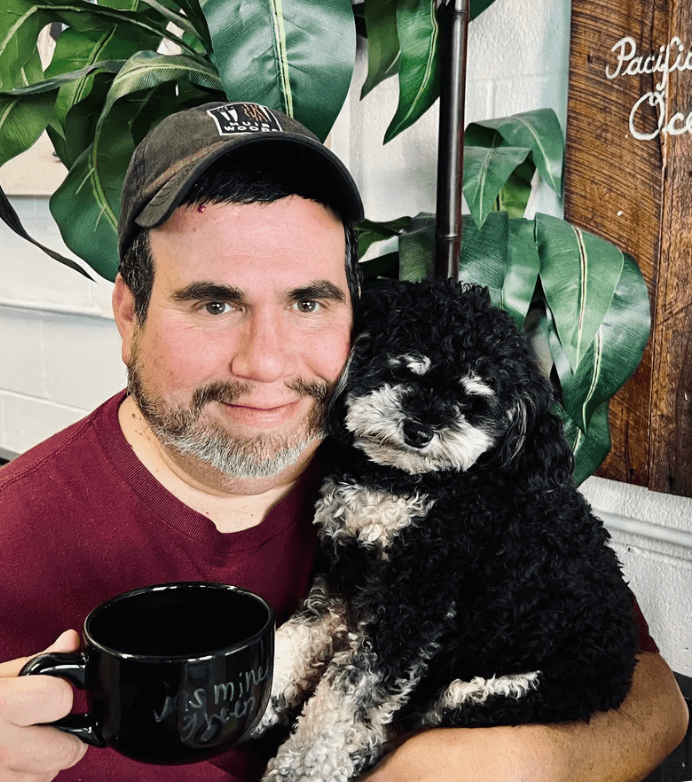



 Jeffrey Reads