
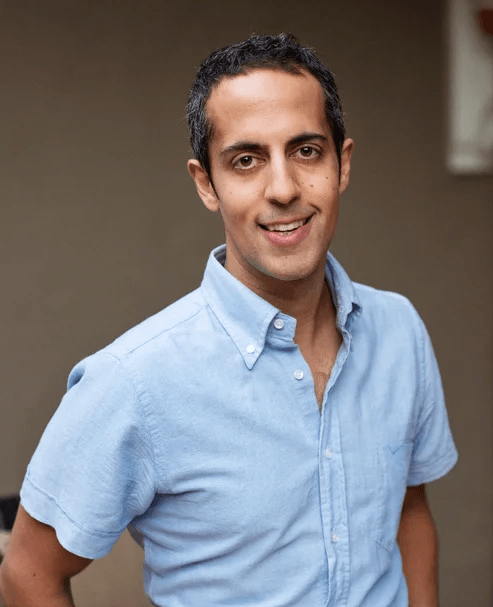
Aside from being the author of a growing list of YA novels, Abdi Nazemian has also worked as a screenwriter for television and film. When we spoke late last year as he was promoting his latest young adult title, he told me that he truly believes all storytellers have the power to cross mediums should they choose to. “Stories can be told in so many forms and ways. Personally, I love traveling across mediums because it keeps life varied and interesting,” he said. “Writing a novel is a solitary creative endeavor that involves hair-pulling, soul-searching solitude. Writing for television is a communal experience that happens with a team of writers that often come to feel like family. So, both experiences feed very different parts of me, both creatively and socially. I love that novels have given me an outlet to tell the kind of personal stories about my queer Iranian life that are far too niche for Hollywood, and I love that Hollywood has given me the chance to work in community with fellow writers to create entertainment that hopefully moves and entertains people.”
Born in Iran, Nazemian grew up not only in Tehran but also Paris, New York, and Toronto, to name a few. When I asked him what kind of cultural amalgamation that left him with as an author and artist, he remarked that moving every few years as a kid is rough. “It meant I never had stable friendships outside of my cousins, and that I was constantly an outsider in new countries, with new languages, social rules, and cultural norms,” he said. But as an adult, he began to see the advantage in being exposed to so many different environments from an early age, naming growing up as an outsider as the great gift of his life. “It’s allowed me to navigate different worlds far more easily than most, and it gave me the curiosity and empathy that all artists need when bringing characters to life.”
Nazemian took to writing from a very young age. “In middle school, I was obsessed with Archie Comics and with various forms of Americana that promised a version of America that was far warmer and more inviting than the real one,” he told me. “So I would write my own Archie stories and submit them. In high school, I took stabs at writing plays and screenplays, all of them unfinished fragments of grand ideas. The truth is I always had the hunger to tell stories in me, but what I lacked was the craft and the discipline. And most importantly, I lacked the belief that being an artist was a possibility at all for me.” The author recalled that being raised in an immigrant culture led him to be steered toward choosing more “stable” professions, and it wasn’t until he worked as an assistant in Hollywood and was tasked with reading piles of scripts every week that he realized writing is a viable career choice. “And that’s when my dream of being a writer turned into a discipline.”
When I asked him how he got into writing novels for the YA genre, Nazemian immediately pointed to the YA books he’d been reading as an adult that served as an inspiration, as well as an educator cousin who would recommend the best books in the genre to him. “Reading authors like David Levithan and Benjamin Alire Sáenz, to name only two, inspired me because I wasn’t seeing the same kind of representation in other spaces,” he said. “I wanted to tell stories that were deeply queer and culturally specific, and that felt like what teen readers were demanding.” As far as any young adult literature he might’ve encountered in his own youth, the author doesn’t think that YA as we know it today existed just a few decades ago. “Please understand that the book I wrote about my own adolescence, Like a Love Story, is marketed as historical fiction,” he chuckled. He’s officially being called an elder in the genre by one of his favorite authors, Jonny Garza Villa, and he happily owns it.
“I write my books to tell personal stories, and each one is straight from my heart.”
Whatever the case, Like a Love Story was chosen as one of Time magazine’s best young adult books of all-time, alongside a slew of other books the author grew up reading like To Kill a Mockingbird, A Tree Grows in Brooklyn, Little Women, Anne Frank’s The Diary of a Young Girl, and The Catcher in the Rye. “Perhaps some don’t consider those books YA, but Time does and I suppose I do, too,” Nazemian said. As far as genre is actually concerned, he’s convinced that’s just another social construct created to help organize the bookshelves of libraries, bookstores, and streaming services. “All stories could easily be slotted into many, many genres,” he affirmed. Nazemian named authors like Becky Albertalli and Bill Konigsberg as influences who wrote “bold queer stories” before him. “I also feel lucky to be writing alongside other queer Iranian authors like Adib Khorram, Sara Farizan, and Arvin Ahmadi,” he continued. “And I have my personal favorite YA authors who show me the limitless possibilities of the category, including Dean Atta, Kacen Callender, Jandy Nelson, Ibi Zoboi, Robin Benway, and so many more.”
In reference to at least one of his YA books being marketed as historical fiction, it’s worth noting that a number of Nazemian’s novels take place in previous eras, focusing on the differing experiences of being queer in other time periods and cultures. When I asked him what his main goal was with this theme for younger readers, the author referred to his own passion for the past first and foremost. “I’m a history nerd and always have been,” he said. “As a teen, my favorite authors were Oscar Wilde and James Baldwin. When my peers were watching new films, I was holed up watching old film noirs, classic musicals, silent films, French New Wave.”
He thinks of himself as always having had a longing for the past. “I think that’s because as a young person, my own history was hidden from me,” Nazemian reflected. “My Iranian history wasn’t shared by my community, because they wanted to shield us from the traumas we escaped. My queer history wasn’t available to me in a homophobic, pre-Internet world. So, I longed to see myself in the past. I truly believe young people need to feel rooted in their history so they can spread their wings, knowing others walked their path before them, knowing they always existed and always will. Perhaps this is why, in addition to Like a Love Story, Only This Beautiful Moment, and Exquisite Things dealing with queer history, they also shine a light explicitly on queer mentorship and on queer resilience.”
Exquisite Things, his latest YA novel published last fall, is the story of two eternal seventeen-year-olds searching for a time and place where their love isn’t a crime, with its protagonists made immortal through the burning of Oscar Wilde’s original manuscript for The Picture of Dorian Gray. “This is a commentary on how any attempt to destroy our stories will only make us stronger in the end,” the author told me. “The Picture of Dorian Gray was once censored and banned. We’re still reading it today, just as I know future generations will discover our banned books and see them as a record of this enraging, beautiful time we live in.” He referred to Exquisite Things as just as personal as his previous books, at least since Like a Love Story was published, which he called the first of his books where he allowed himself to be truly vulnerable on the page. “I write my books to tell personal stories, and each one is straight from my heart,” he explained. “But this one was especially difficult to write, because it required research far beyond previous books as a result of the many time periods the book covers, from 19th-century London to Boston in 1920 to London in the early 1980s and onward.”
“I’m stubbornly holding on and am trying to be even more queer and more political in my storytelling, because authoritarianism succeeds when we all choose to remain silent in the face of the threats that come with being vocal.”
Since Nazemian’s first YA novel came out in 2014, that particular publishing landscape has changed a hundred times over. “It’s much harder now,” the author admitted, pointing to the rise in book bans in the United States, which he says have decimated sales and made the landscape for writing books like his infinitely harder. “They’ve also broken the hearts of authors like me, who know from experience how meaningful these books can be if they find their way to teens who need them,” he said. “I’m stubbornly holding on and am trying to be even more queer and more political in my storytelling, because authoritarianism succeeds when we all choose to remain silent in the face of the threats that come with being vocal. I also know, as a student of history, that everything is cyclical. There will come a day when this wave of repression ends, and when that day comes, all the books me and my fellow authors have written will still exist, ready to be discovered by readers who need them. Hate never survives, but art does, love does, community does.”
This is a subject in which the author happens to be well-versed, since several of his YA books have been challenged or banned in the United States in recent years. “I believe my books are banned first and foremost because they show teen readers how their community fought back during previous repressive eras,” Nazemian told me. “Like a Love Story shines a light on how ACT UP fought back when the government turns its back on a community. Only This Beautiful Moment shines a light on how the queer community in Iran survives despite the repressive regime still in place. Exquisite Things travels from the London of Oscar Wilde’s trial to the current day, with many stops along the way, to show how the queer community has survived countless attempts to eradicate and silence us.”
What he wants his younger readers to take away from this is that we can and must learn from the best of history, to the best of our abilities. “We must study the heroes of the past so that our actions can be effective. And on an emotional note, I just want them to know they’re not alone.” As for what he’s cooking up next, Nazemian alluded to two future books but confessed that he’s too superstitious to reveal anything further about them yet. We can also expect to see his name in the writing credits for two different series this year, such as Sweet Magnolias on Netflix and It’s Not Like That on Prime Video.
This interview has been slightly edited for length and clarity. Follow Abdi Nazemian on Instagram and get his latest novel Exquisite Things from your local indie bookstore or library.
 Jeffrey Reads